
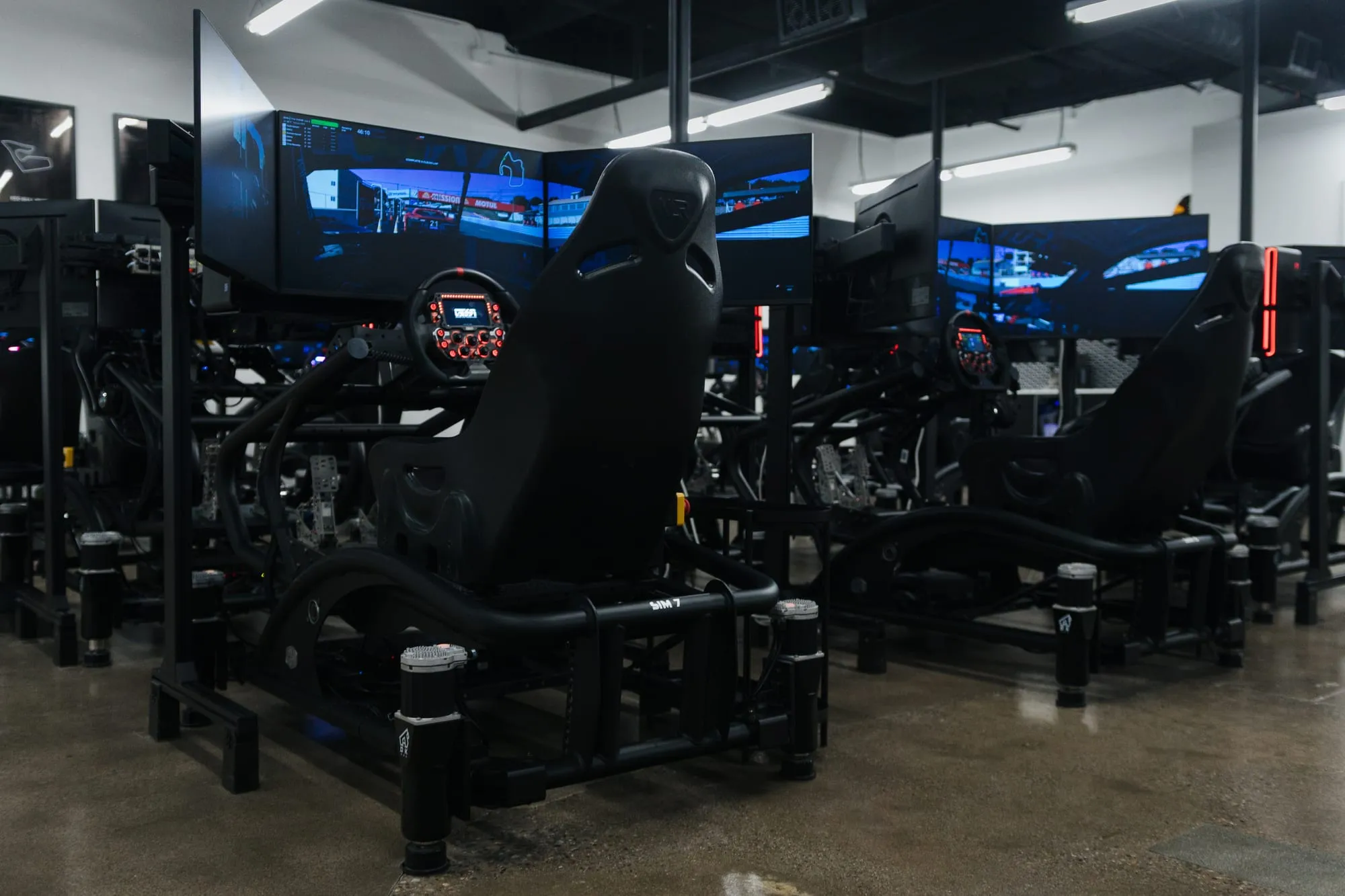
Sim racing is driving a virtual race car on a virtual track, both built to real-world specs. The physics are modeled on the actual car. The track is a laser scan of the real circuit, measured down to the curbs and the dips. The wheel pushes back against your hands the way a loaded tire does. What’s missing is the entry fee, the trailer, the crash damage, and the drive to the circuit.
How Sim Racing Differs From A Racing Game
Graphics are the first thing anyone looks at and the part that matters least. What separates a simulator from a racing game is the math running underneath them.
A racing game is tuned to feel good. A simulator is tuned to be accurate. We run Assetto Corsa, and while you’re driving it’s working out tire temperature, how much grip is left at each corner of the car, how weight shifts forward when you brake and sideways when you turn, how the suspension loads up and lets go, and how air moving over the body presses the car into the road at speed.
So the car rewards what a real one rewards. Brake in a straight line. Get it turned before you ask for power. Keep your hands quiet. Do the opposite and you get a real car’s answer: the back steps out, or the front washes wide, and there goes half a second you won’t get back.
It’s also why lap times here mean something. You’re setting a time on the same corners, in the same car, that somebody somewhere is trying to set for real.
What A Full-Motion Simulator Actually Feels Like
A simulator is only as honest as the hardware telling your body what’s going on. Ours comes down to four things.
- The motion. The whole cockpit sits on a Sigma Integrale DK2+ motion system. It pitches forward under braking, rolls as the car leans into a corner, and drops out from under you when the track drops. Your inner ear is a sensor real drivers lean on constantly, and giving it something true to read is the difference between watching a car slide and feeling one start to go.
- The wheel. A Simucube 2 Pro drives the wheel straight from the motor, just smooth transfer of feeling out to your hands. You feel the front tires load up through a corner, you feel the moment they give up, and you feel a curb before you’re all the way across it.
- The brake. VRS DirectForce Pro pedals measure how hard you press rather than how far you push, exactly like the pedal in a road car. It sounds like a detail. It turns out to be the main reason people get quicker here, because braking stops being a button and becomes a pressure you can learn and repeat.
- What you see. Three 32 inch screens wrapped around you at 180 degrees, running at 180Hz, set to the field of view that puts the world at the right size. Your apex, your brake marker, and the car trying to get up the inside of you all sit where your eyes expect them.
Braking is the thing almost everyone gets wrong first, and the thing that makes the biggest difference once you fix it.
What Happens In Your First Session
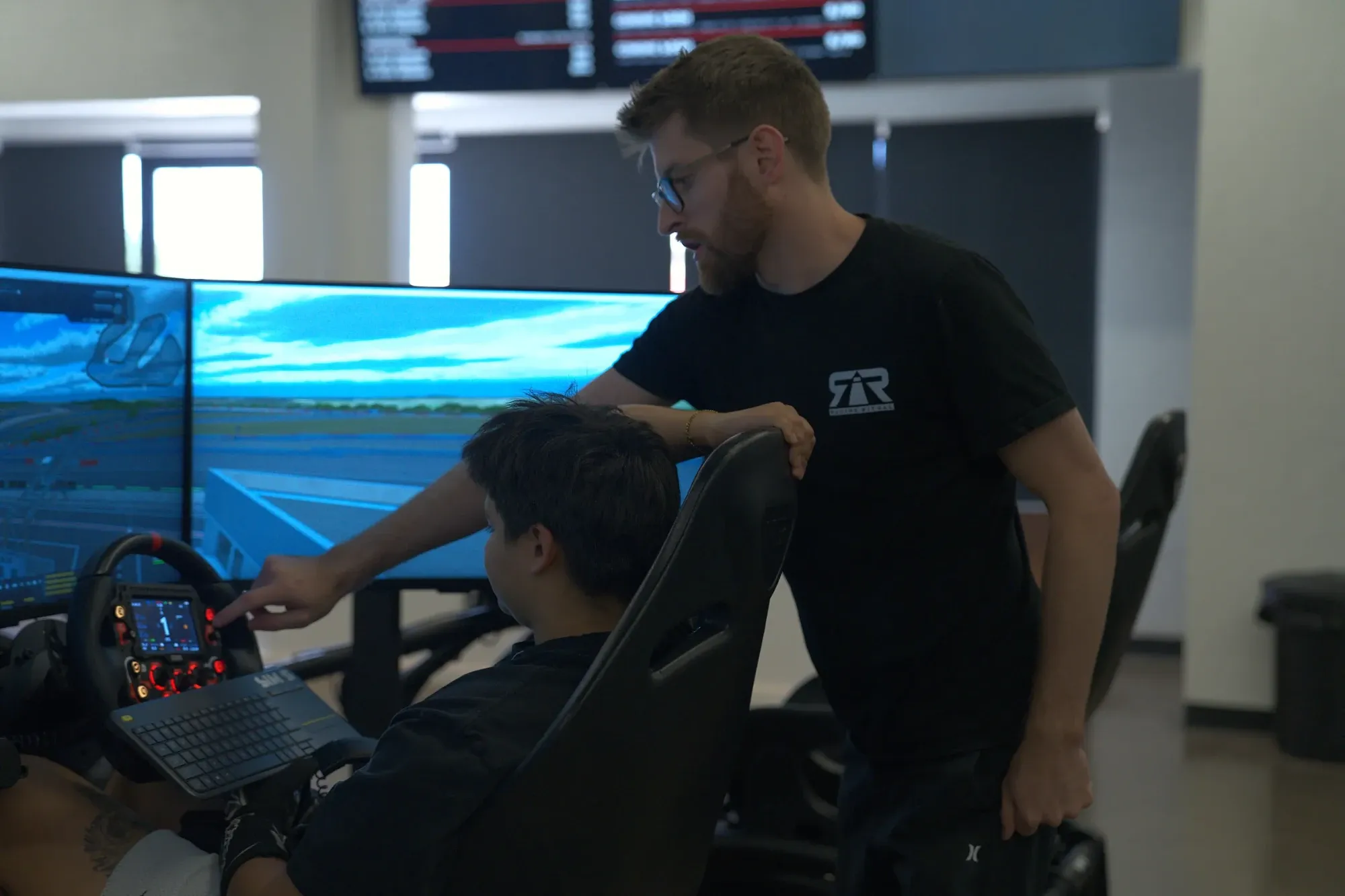
Every session starts with someone walking you through it.
You arrive, sign a waiver, choose a duration, and pick a car and a track. There are GT3 and GT4 cars, formula cars, NASCAR, IndyCar, Supercars and road cars, and tracks running from circuits down the road to the ones you have watched on TV your whole life. If you have no idea what to choose, say so. There are a couple of combinations we put first timers in for a reason, and they’re the ones that make the first ten minutes fun instead of frustrating.
Then, someone walks you over to a rig and guides you through adjustments, seat and pedals. Then a short orientation, so nobody is sitting there guessing which pedal is which and what buttons do what.
Your first laps will be slow, which is correct. Somewhere around lap five it clicks. The controls drop out of your head and the corner takes their place, and that’s the part people come back for.
Do You Need Any Racing Experience?
No. Most people who sit down here have never sim raced let alone driven a race car and never will, which is fine. Driving aids can be turned on, and the motion can be turned off if you’d rather ease into it. Tell us when you arrive and we’ll start you somewhere comfortable and build from there. There’s more on all of this in our FAQ.
The other half of the room is the opposite: people chasing tenths on a track they already know by heart, running the same lap forty times to find a better line through one corner. Race nights and the monthly fastest lap challenge exist for them. Same equipment either way. Only the goal changes.
Where To Try Sim Racing In Tempe
We run 12 full-motion simulators on University Drive in Tempe, in the east Phoenix metro, open seven days a week. Hours and directions are on the contact page. You can book an hour on your own, bring a group, or take the whole floor.
Reading about force feedback is a poor substitute for feeling it. If you’d rather watch a race night before you drive one, the calendar has the dates.